
If you’re already doing the work, the next question is simple: how do you squeeze the juice out of it?
Most entrepreneurs treat marketing like a treadmill. You create a webinar, send a follow-up email, maybe post a YouTube clip, and then you start over from scratch. But there is a smarter loop: turn one “core asset” into a whole ecosystem of content that keeps generating leads, engagement, and trust.
This is the mindset behind Business Ownership Coach | Investor Financing Podcast style growth: build a top-of-funnel that compounds, and use AI to multiply distribution so you are not relying on “more effort” for “more results.”

Photo by Markus Winkler on Unsplash
“Squeeze the juice”: grow by extracting more value from what you already created
The key idea is that growth is not always about getting more people. It’s about squeezing the people you already reached, and the content you already built.
Instead of asking, “How do I get more leads this month?” ask, “How do I get more mileage out of the leads and attention I already earned?”
Turn one event into many conversion points
Think about what happens after you run a live event. You might:
- Send an email with a call to action
- Upload a recording to YouTube
- Occasionally repurpose a highlight
That’s a start, but it is not “squeezing.” When you fully repurpose, you’re building multiple entry doors into your funnel: social posts, reels, newsletters, blog content, podcast episodes, and more.
Webinar show-up rates: improve the live event pipeline
There’s also a practical lever people miss: show-up rate. If you are getting, say, a 16% show up rate from RSVP, you can typically estimate that only a portion of your top-line audience will actually attend live.
A simple method that increases live participation is to offer a bonus only to people who attend live. When you do that, your live session becomes more valuable, which gives your repurposing engine better raw material (more watch time, more engagement, more credible takeaways).
Repurpose smarter: the “10 things on every webinar” method
One of the biggest unlocks in this whole strategy is moving from “random repurposing” to a repeatable checklist.
A practical workflow mentioned is doing at least 10 repurposing actions per webinar. Not because 10 is magical, but because consistency beats one-off creativity.
Use AI prompts to extract reusable content blocks
A powerful prompt strategy is to extract:
- Top quotes from the webinar
- Key statistics or “stat nuggets”
- The ideas most likely to resonate with aspiring business owners
Then convert those into a series of social posts. For example: create five unique social media posts with captions and hashtags designed to drive engagement and interest.
Build a prompt library so you never start from zero
Here’s the real “system” advantage: you need a place to store those prompts. When a webinar comes in, your process should automatically generate:
- Five to ten social media posts
- A blog-style post or “webinar recap” block
- Email follow-ups powered by AI
- Short reel snippets
- Memes or image-based formats when appropriate
Instead of spending hours after every event, you build an assembly line that turns one live session into a week or month of content.
Engagement is not optional: match the hook to the audience

Repurposing fails when you treat content like text to be reshuffled. People don’t just want information. They want:
- A reason to care (the hook)
- A clear takeaway (what to do next)
- Proof you know what you’re talking about
That’s why the “subject line” and the internal message matter. AI can help, but your messaging has to be intentionally written for humans, not just optimized for outputs.
In other words: extract the most compelling ideas, then repackage them so the first sentence earns the click.
Know your avatar and your ecosystem (or your content won’t compound)

Omnipresence sounds great, but it still needs direction. Before you distribute everywhere, you have to know who you’re trying to reach.
Target one person, then attract the tribe
A useful framing is:
- Pick one specific person (age, demographics, habits, buying triggers)
- Craft your message so it resonates with that person
- Let the “similar profiles” self-identify and join your ecosystem
Then build trust over time. Don’t “zap” people into a purchase. Take them on a transitional journey where they repeatedly see value, proof, and clarity.
Tools that help you become “everywhere” (and still measure ROI)
AI tools are only useful if they create a real return. The strategy is to measure ROI in the way that matters to you:
- Buying back time (less manual work, faster turnaround)
- Generating business (more leads, more conversions, more sales)
When a tool does neither, it’s just a subscription.
Podcast and transcription workflows
For podcast publishing and transcription, Castmagic is one example mentioned. The value is that it can handle uploading and transcription so you can quickly turn long-form audio into repurposed content.
Descript is another workflow referenced, especially for trimming ums and “dead air” and creating cleaner blog posts, newsletters, and social assets from spoken content.
Omnipresence through platform stacking
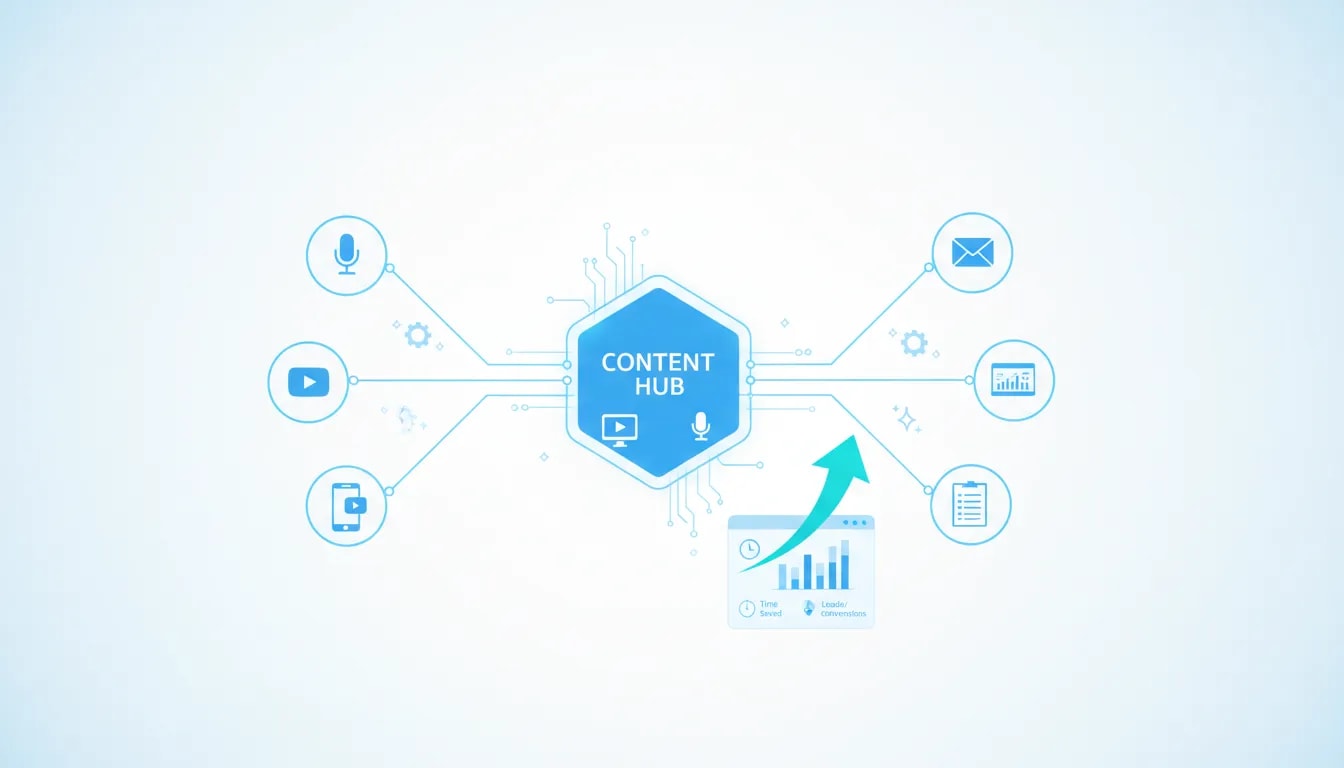
The goal is to become “everywhere” without increasing your workload. For example:
- Webinars feed podcast and YouTube
- Podcasts feed social clips and reels
- Social clips lead people into your email list and offer pages
- Email and newsletters reinforce credibility and momentum
When content is distributed like this, attention grows from thousands to tens of thousands to more, because people encounter your message repeatedly across different platforms.
Clip generation and social proof
Tools like Opus Pro/Opus Clips were referenced for cutting and rewriting scripts based on selected platforms. Another tactic: if you are a guest on podcasts or shows, you can grab the relevant URLs and let AI generate clips that highlight your expertise, which becomes social proof.
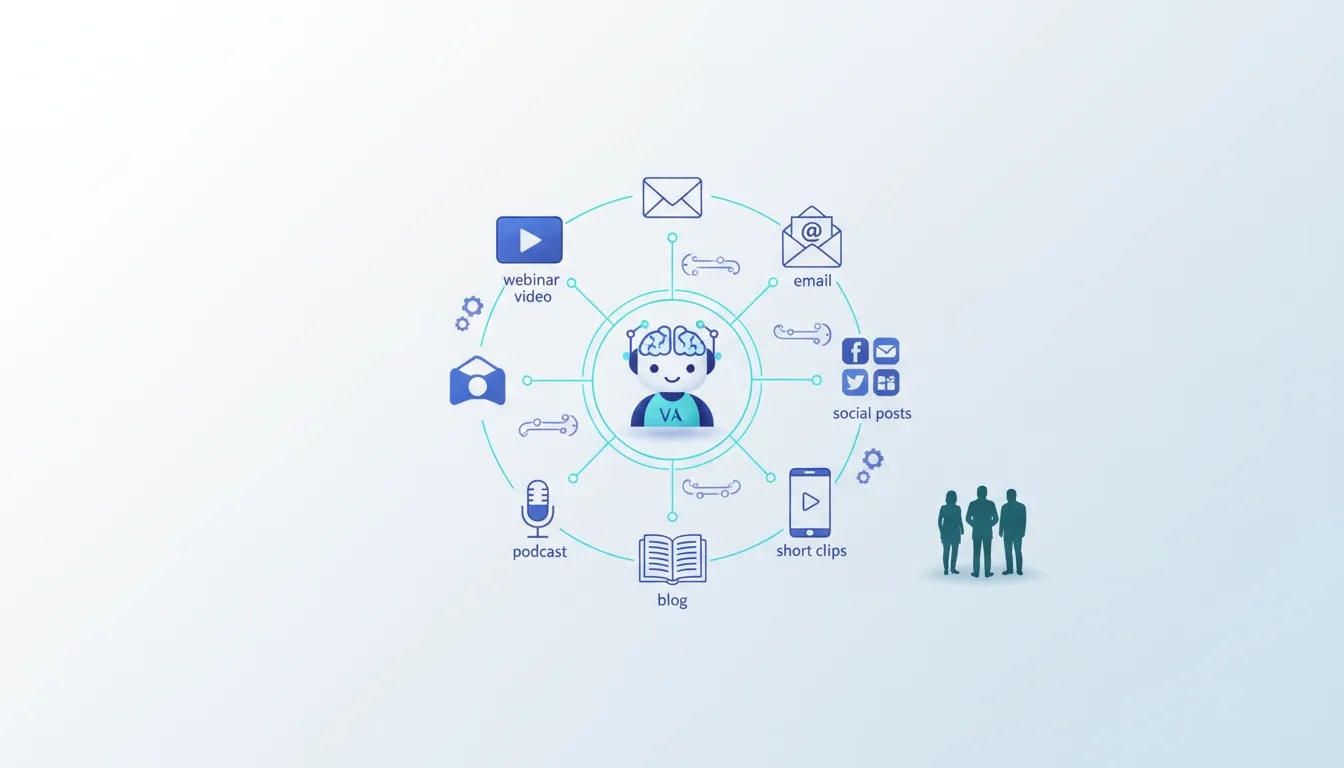
And a virtual assistant (VA) can do a lot of the “grunt work” here: locating source videos, downloading them where allowed, and feeding them into your content engine.
Build a VA-driven system so content scales with your team
One of the biggest “squeeze the juice” advantages is infrastructure. You don’t need to do everything personally.
A strong approach is:
- Learn the process enough to define requirements
- Write clear instructions for your VA
- Let the VA execute repeatable steps so you can focus on strategy, offers, and coaching
This matters even more when ticket sizes are high. If you’re selling something expensive, your audience often wants your personal involvement. Repurposing helps attract the right people, but conversion may still require your voice, your track record, and your sincerity.
Why this creates “compounding” reach (not one-and-done marketing)
Here’s the compounding effect described: instead of touching 2,000 people through a single channel, repurposing can help you touch 10,000 to 15,000 through multiple formats.
Even if each format only gets a slice of attention, the total footprint expands. And because trust grows each time someone sees you deliver value, your conversion rates improve over time.
Paid ads work better when you already built trust
Ads can amplify what’s already working. A useful insight shared is that the best ads often come from:
- Student results and testimonials
- Real outcomes (for example: facilities or deals becoming successful)
- Social proof that reduces buyer anxiety
So your content system is not only for organic growth. It’s also fuel for paid promotion.
Case focus: senior assisted living, real estate, and niche expertise
In the senior living and multifamily space, credibility is everything. Repurposing turns one learning experience into a library of trust-building assets.
The niche example discussed involves:
- Residential assisted living concepts
- How to avoid blunders
- Location research and operator selection
- Financing pathways like SBA 7(a) and DS loans
- Seller financing and insurance considerations
This kind of depth is hard to compress into a single post, which is exactly why webinars and long-form interviews matter. AI makes it easier to distribute the depth across many formats.
Courses and coaching: use ROI thinking to increase course completion and outcomes
Repurposing helps attract people. But you also want people who actually execute.
A course/coaching insight shared is to reduce “tire kickers” by making participation structured:
- Require a goal sheet before deeper sessions
- Hold a 1-hour session to dig deeper
- Only move forward when someone is genuinely ready
This is ROI thinking applied to education. When students show up prepared, you increase outcomes, testimonials, and referrals, which then feeds back into the content engine.

Set your 2026 growth system: mentor, content, and a bigger top-of-funnel
If you want a simple principle to carry forward, it’s this: find a mentor, get coached, and build better content.
Then use AI and repurposing to grow your top-of-funnel. More leads create more financial opportunity, and repetition builds brand trust.
Start with one webinar next week. Use a repeatable repurposing checklist. Turn that core asset into:
- Social posts
- Reels snippets
- A blog recap
- An email sequence
- A podcast episode
- Clip-based social proof
That’s how you squeeze the juice.
Take action today
- Create a prompt library for webinar repurposing
- Define your avatar so every post has a clear hook
- Choose 2 to 3 distribution platforms to start, then expand
- Assign VA tasks to feed your content system
- Measure ROI as time saved or business generated
Do this consistently and your content will stop being a one-time effort. It becomes an asset that keeps working for you, week after week, year after year.