
A Business Ownership Coach helps prospective franchisees look beyond a brand name and evaluate the business model, financial commitment, operating requirements, and long-term fit. Home service franchises can be attractive because many operate without expensive retail storefronts, often using a home office, vehicles, and limited warehouse space.
But lower overhead does not automatically mean lower risk. The strongest opportunity is the one that matches your capital, skills, lifestyle goals, territory, and ability to follow a proven system. Whether you are considering pest control, restoration, painting, fencing, roofing, plumbing, HVAC, or property maintenance, use this framework before committing to a franchise agreement.

Photo by LinkedIn Sales Solutions on Unsplash
Key Takeaways
- Recurring revenue and customer contracts can make home service revenue more predictable.
- Emerging franchises require greater diligence because their operating history may be limited.
- The Franchise Disclosure Document reveals the investment range and available financial performance information.
- Choose a franchise system that fits your financial capacity, goals, and preferred owner role.
Why Home Service Franchises Appeal to Business Buyers
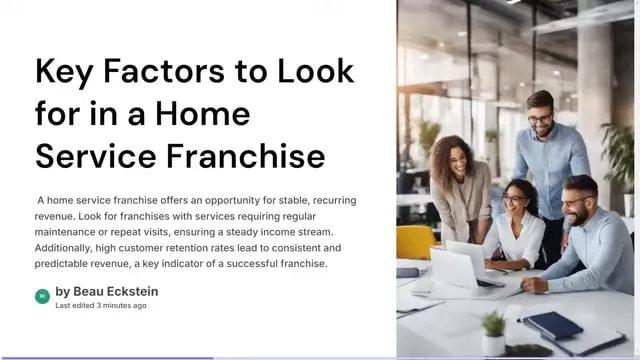
Home services cover a wide range of essential and recurring household needs. In many cases, the franchisee does not need a customer-facing retail location. Instead, the operation may be managed through scheduling, local marketing, trained technicians, service vehicles, and a modest storage or warehouse setup.
That structure can reduce the fixed costs associated with traditional retail franchises. It also gives owners flexibility in how they build their team. The owner may focus on sales, customer relationships, hiring, operations, local partnerships, or strategic growth while trained employees perform technical work.
A Business Ownership Coach should help you separate the service category from the business model. A franchise can offer a great service, but still be a poor fit if its staffing demands, sales cycle, working hours, or cash requirements do not align with your goals.
Prioritize Recurring Revenue and Contracted Customers
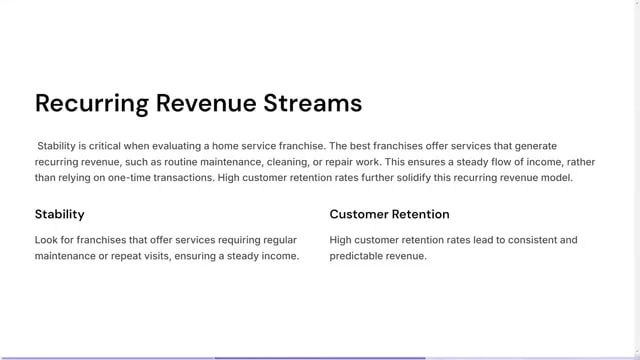
One of the first questions to ask is simple: How often does the same customer buy? Recurring revenue can provide a more stable foundation than a model built entirely on one-time jobs.
For example, a pest control customer may receive service monthly, quarterly, or on another recurring schedule. Property maintenance businesses may return regularly for services such as gutter cleaning, window cleaning, filter changes, smoke detector checks, water softener maintenance, and other routine household needs.
Recurring revenue does not eliminate the need for sales and service quality. It does, however, help an owner estimate staffing needs, route density, customer retention, and expected future work more clearly.
When reviewing a home service franchise, ask:
- What percentage of revenue comes from repeat or subscription customers?
- Are customers under contracts, and what are the common contract lengths?
- Are agreements typically 12, 24, or 36 months?
- What causes customers to cancel or not renew?
- How does the brand support retention and customer service?
- Can recurring services lead to additional one-time repair or upgrade work?
Also examine whether the franchise can access larger commercial, multifamily, or property management relationships. A property manager with hundreds of doors may create a meaningful service opportunity, but you need to understand the pricing, service-level expectations, payment timing, and concentration risk before treating one account as a growth plan.
Compare Emerging and Established Franchise Brands
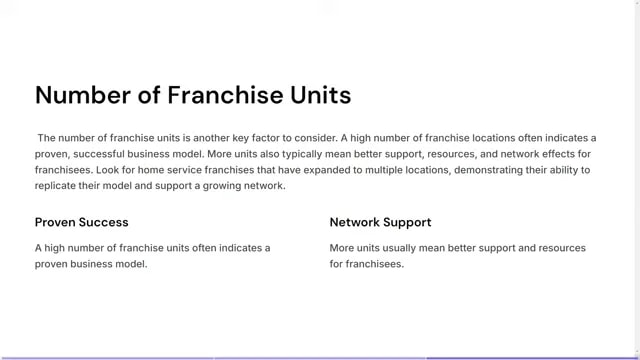
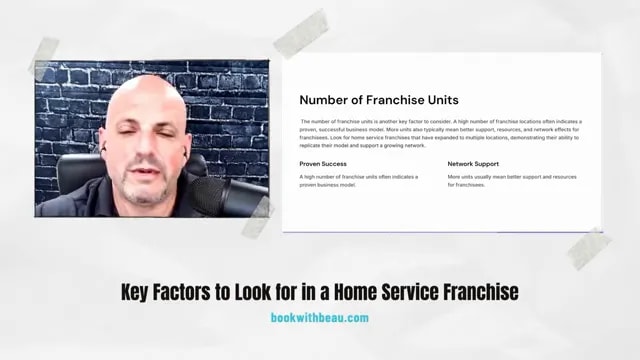
The number of operating franchise units matters, but bigger is not automatically better. An established franchise may offer a longer operating record, more franchisee references, refined training, and wider support infrastructure. An emerging brand may have more open territory and a leadership team with strong momentum.
The tradeoff is evidence. With a newer system, you may be placing greater weight on the founder, management team, operating playbook, and the experience behind the brand. A Business Ownership Coach can help you assess whether the system is truly repeatable or still being developed in real time.
For an emerging franchise, focus your diligence on:
- The leadership team’s prior business and operational experience
- The clarity of the training, marketing, sales, and service systems
- The availability of protected or open territories in your market
- The number of company-owned, affiliate, and independently franchisee-owned locations
- The amount and quality of financial data available for review
- Whether support can keep pace as the network grows
A small unit count is not necessarily a red flag. It simply means you should not assume that a limited sample of results represents every territory or every future franchisee.
Use the Franchise Disclosure Document as a Decision Tool
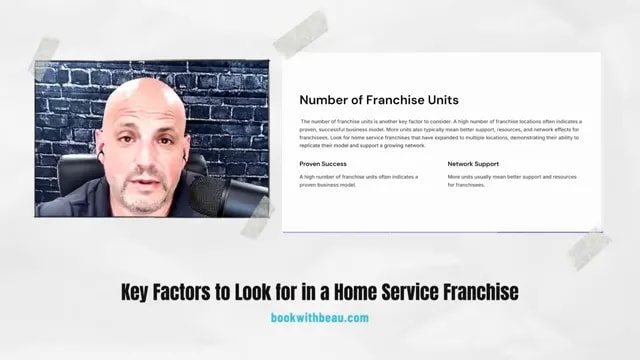
After your initial discussions with a brand, you will generally receive its Franchise Disclosure Document, commonly called the FDD. This document follows a standardized disclosure format overseen through Federal Trade Commission franchise disclosure requirements. It is not light reading, but it is one of the most important documents in your buying process.
Two sections deserve immediate attention:
- Item 7: The estimated initial investment range, including the franchise fee, equipment, working capital, and other anticipated startup costs.
- Item 19: Financial performance representations, if the franchisor elects to provide them.
Do not treat Item 19 as a promise. A financial performance representation may contain different types of data and may not represent the exact circumstances you will face. In newer systems, the information may be limited or based on a corporate, affiliate, or flagship location. Ask whether the results shown represent one territory, multiple territories, company-owned operations, or franchisee-owned locations.
A practical approach is to build a side-by-side diligence worksheet for each brand. Track the Item 7 range, recurring revenue structure, staffing model, territory availability, training, contract terms, franchisee support, and your own working-capital comfort level. The goal is not to find a perfect franchise. The goal is to identify the risks you understand and can manage.
Do You Need HVAC, Plumbing, or Trade Experience?
Not necessarily. Many franchise owners enter home services without prior technical experience in HVAC, plumbing, restoration, or other trades. The critical question is whether the franchise has a strong system for recruiting, training, managing, and retaining qualified technicians.
Your role may be closer to that of a business operator than a field technician. You may be responsible for generating leads, managing sales, reviewing production, maintaining customer satisfaction, building local relationships, and running the financial side of the business.
That said, no experience does not mean no responsibility. Before buying, understand who performs the work, how technical quality is controlled, what training is provided, and how the operation handles staffing shortages. A capable Business Ownership Coach will challenge you to define whether you want to be owner-operator, manager-led, or pursuing a semi-absentee structure while maintaining another career.
Match the Franchise to Your Capital and Lifestyle Goals
Franchise selection should begin with your personal investment thesis, not a list of popular brands. Clarify your available capital, financing strategy, risk tolerance, desired income timeline, geographic area, leadership skills, and day-to-day availability.
A home service franchise that suits a full-time operator may not fit an executive keeping a corporate job. A business with strong recurring revenue may still require hands-on sales leadership during the startup phase. Likewise, a lower initial investment can still require sufficient working capital while the customer base and team are built.
It is wise to review several concepts rather than becoming emotionally committed to the first brand you encounter. Consider a mix of startup and resale opportunities. A startup may offer a fresh territory and the ability to build from the ground up. A resale may offer an existing customer base and operating history, but it requires careful review of why the business is being sold and what operational work remains.
Common Home Service Franchise Mistakes to Avoid

- Choosing only by industry familiarity: A business model can be a better fit than the sector you initially prefer.
- Ignoring working capital: Initial investment is not the same as the cash needed to operate through ramp-up.
- Assuming financial data guarantees results: Use disclosures as diligence material, not a personal earnings forecast.
- Overlooking culture: You are buying your own business, but you are also joining a franchise system and support network.
- Failing to understand account concentration: Large property management or national accounts can be valuable, but dependency must be evaluated.
- Buying a semi-absentee concept without confirming the workload: Your desired ownership role must match the real operating demands.
Next Steps for Evaluating a Franchise Opportunity

The most effective franchise search is a disciplined process. Start by identifying your financial capacity and desired role. Then compare multiple brands, review the FDD carefully, assess recurring revenue and contract structures, and determine whether the franchisor’s culture and leadership team are right for you.
If SBA financing may be part of your acquisition plan, schedule an SBA lending discovery call to discuss the funding side before you become too far committed to a specific opportunity. You can also book a business ownership strategy call for help evaluating startup franchises, franchise resales, and financing options.
For additional franchise education and business ownership resources, consider joining the Business Ownership Academy community or subscribing to the business ownership newsletter.
Home Service Franchise FAQ
What is the most important factor in a home service franchise?
Look for a business model with clear demand, a repeatable operating system, adequate working capital requirements, and ideally recurring customer revenue through service plans or contracts.
Can I own a home service franchise without trade experience?
Yes. Many owners operate the business side while trained technicians perform service work. You should still understand the franchise’s hiring, training, quality-control, and staffing systems.
What should I review in the Franchise Disclosure Document?
Start with Item 7 for the estimated initial investment and Item 19 for any financial performance representations. Review how the available data was generated and whether it applies to comparable locations.
Should I buy an emerging or established franchise?
Either can be appropriate. Established brands may offer a deeper operating history, while emerging brands may offer wider territory availability. Your diligence should reflect the amount of proven performance data available.