
A high salary can pay the bills without building much financial security. A Business Ownership Coach helps you think beyond income: which business could generate cash flow, how might you finance it, and what would you do with the money it produces?
One useful framework has three connected parts: an operating business, long-term real estate, and deliberate tax planning. The sequence matters. Build a business that can support itself first, protect its cash reserves, then consider using genuine surplus to acquire other assets. None of this is automatic, but it gives every dollar a job.
What Does a Business Ownership Coach Actually Help You Decide?

Photo by Blake Wisz on Unsplash
A Business Ownership Coach should help you define the business you are willing and able to run, not simply point you toward an attractive industry. That means discussing your available capital, transferable skills, desired role, location, household income, and tolerance for managing employees.
The result is a buyer box: a set of criteria for comparing opportunities. It might specify a local, service-based business with modest overhead and a small initial team. Another buyer may prefer an established acquisition with employees already in place. Either can make sense if the numbers and responsibilities fit.
Start by comparing at least a few paths: a new franchise, a franchise resale, an independent business acquisition, and a startup. Do not choose solely because you like the product. Find out what you, as the owner, must do every week.
Why Put an Operating Business at the Center of the Plan?

Photo by Jakub Żerdzicki on Unsplash
Real estate can be a valuable long-term asset, but a few rental properties may produce less spendable cash than expected once repairs and major replacements arrive. An operating business has its own risks, including payroll, customer acquisition, and day-to-day management. Its potential advantage is the ability to improve cash flow by serving more customers and building repeatable systems.
The goal is not to drain the business to buy property. It is to establish reliable operations, retain enough working capital, and invest from what remains. For a service company, useful measures include leads, booked appointments, revenue per crew or vehicle, marketing costs, and cash left after expenses and debt payments.
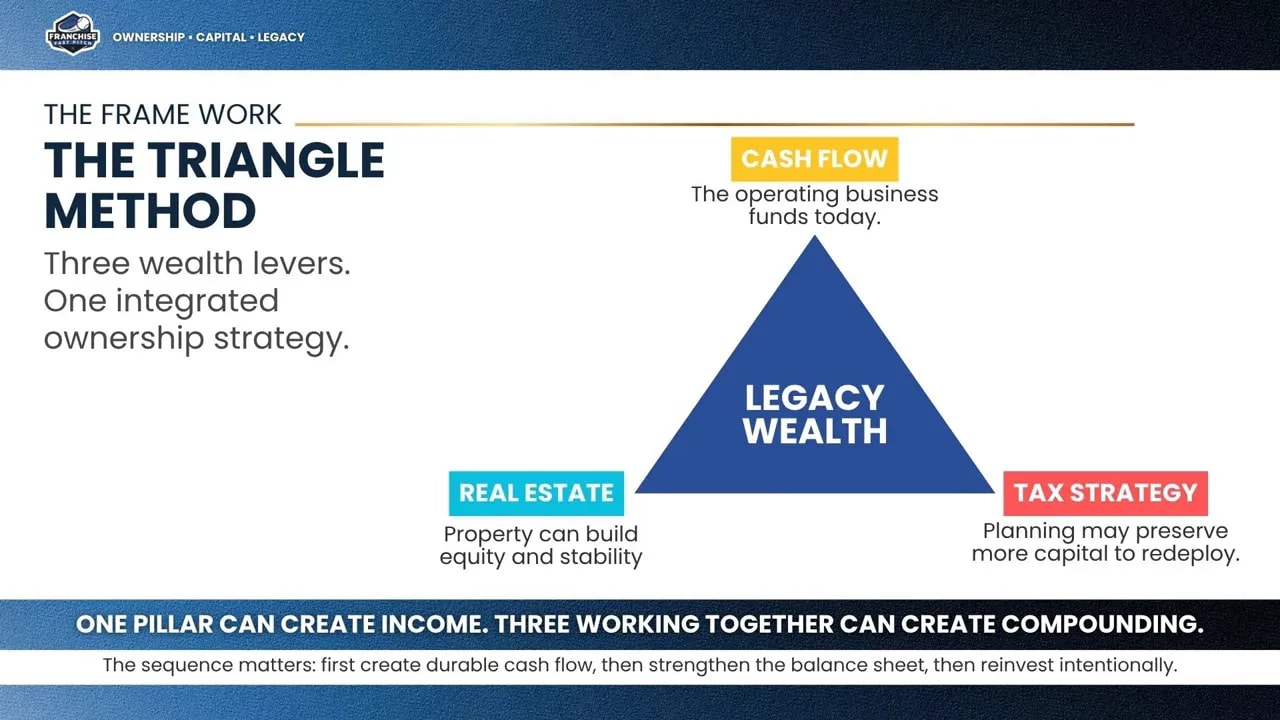
Think of the triangle as a planning tool, not a promise of returns. The business may create cash flow; real estate may add another long-term asset; tax planning helps you understand the consequences of each decision.
Franchise, Resale, or Independent Acquisition?
A franchise gives you an established system to evaluate, often including operating processes, training, marketing support, and access to other owners. That structure can appeal to a first-time buyer. It does not remove the need to sell, hire, manage, and solve problems.
Service franchises deserve a look beyond familiar food brands. Home services, business-to-business services, children’s activities, and senior-focused services are examples of categories to investigate. A lower-overhead model may avoid some of the build-out, permitting, and lease costs associated with a large storefront, though its actual economics still need validation.
A resale offers operating history, but history can reveal trouble. Declining revenue made one franchise resale unsuitable for the SBA financing initially sought; the buyers instead negotiated substantial seller financing. That solved one funding issue but did not provide the same opportunity to include additional working capital in the loan.
“Semi-absentee” is not the same as passive. An owner keeping a full-time job may still need significant time to learn the system and build a dependable team. Treat any forecast of limited owner hours as a later-stage goal to verify with existing owners, not as your starting schedule.
How Do You Evaluate a Franchise Before Buying?

Ask for the Franchise Disclosure Document (FDD) and examine its 23 items with qualified advisers. Item 7 sets out the estimated initial investment. If the franchisor makes a financial performance representation, look for it in Item 19. Read those figures alongside the assumptions behind them; strong-performing locations do not establish what a new territory will earn.
A practical diligence checklist includes:
- Owner role: What must you handle during launch and after hiring a manager?
- Unit economics: What drives revenue, and what do labor, marketing, vehicles, and other costs consume?
- Working capital: How long could you cover expenses if sales ramp more slowly than planned?
- Validation: What do current and former owners say about support, staffing, and results?
- Territory: Is there enough demand, and can you realistically oversee the area?
Be especially careful with the working-capital estimate in Item 7. An estimate covering only the early months may not match your actual ramp-up. Build your own cash-flow plan and test a slower-sales scenario before deciding how much funding you need.
Where Can SBA Financing Fit in 2026?

Photo by Scott Graham on Unsplash
SBA financing can help fund an eligible business purchase, launch, expansion, or owner-occupied property. The SBA 7(a) program is a flexible option for business transactions, while SBA 504 financing is commonly considered for qualifying fixed assets such as commercial real estate. The SBA generally guarantees a portion of a lender’s loan; a participating lender makes and underwrites the loan.
Consider a hypothetical service franchise requiring $150,000 for startup costs and working capital. If a lender approved financing for 90% of eligible project costs, the remaining 10% would be $15,000. That is an illustration, not an available offer or a guaranteed down payment. Loan structure depends on the project, borrower, lender, and rules applicable when you apply.
Expansion financing can also be worth exploring after a business has an operating record. But do not assume a second territory or a building can be purchased with no cash. A lender will assess the existing business, repayment ability, credit, experience, and the proposed transaction. For a deal-specific review, you can request an SBA discovery call.
When Should Real Estate and Tax Planning Enter the Picture?

Real estate becomes more compelling when the business has stable cash flow and you can invest without weakening operations. That could eventually mean buying a rental property or, where appropriate, the building your business occupies. A property tied to an operating business is not the same transaction as a passive rental, so match the financing plan to the intended use.
Tax planning belongs in the discussion from the beginning, even if a major property purchase is years away. Business expenses, retirement arrangements, depreciation, and entity structure can affect after-tax results. Yet a purchase is not worthwhile merely because it may create a deduction. Rules concerning vehicle deductions, bonus depreciation, cost segregation, and whether losses can offset other income depend on the facts and current law. Work through any proposed strategy with a qualified CPA or tax attorney.
A Practical First Step: Build Your Buyer Box
A Business Ownership Coach can help you turn a broad goal into a shortlist you can investigate. Before scheduling calls with sellers or franchisors, write down your answers to five questions:
- How much can you invest while preserving household and business reserves?
- Do you want to operate full-time, or do you need to keep your job?
- Which skills can you transfer into sales, operations, or team leadership?
- What size team and geographic area can you realistically manage?
- What evidence would convince you the business can meet its obligations?
Then compare several opportunities against the same criteria. If you want a starting point for that exercise, the Business Ownership Assessment is designed to help identify business models worth exploring.
The strongest plan is rarely “buy a business, borrow as much as possible, and become passive.” It is more disciplined: choose a business you understand, fund it with adequate reserves, learn its numbers, and earn the right to expand. That is how business ownership can become the first part of a broader wealth strategy.