
If you are trying to grow a business without adding unnecessary overhead, combining virtual assistants with AI can create a faster, leaner operating model. In the Business Ownership Coach | Investor Financing Podcast space, this topic matters because business owners need practical ways to save time, increase output, and stay focused on revenue-producing work.
The core idea is simple. Let AI handle speed, drafts, and repetitive first-pass work. Let virtual assistants handle execution, organization, quality control, and follow-through. When those two pieces work together, one team member can often accomplish far more than a traditional workflow allows.
This guide explains how to use that model in a real business, what tasks to assign to VAs, where AI fits best, and how to get started without overcomplicating everything.
What using VAs and AI together actually means

Most business owners think about outsourcing and automation separately. That is usually a mistake.
The better approach is to treat them as a system:
- AI creates speed by drafting, summarizing, generating ideas, and reducing manual effort.
- Virtual assistants create consistency by operating tools, managing workflows, improving outputs, and completing tasks end to end.
- SOPs connect the two so work gets done the same way every time.
That is one of the most useful takeaways from the Business Ownership Coach | Investor Financing Podcast approach. The goal is not to replace people with software. The goal is to help people use software so the business gets more done with less friction.
Why this model is attractive for entrepreneurs and small teams

Small businesses often hit the same bottlenecks:
- Too much admin work
- Not enough time for sales or strategy
- Content creation takes too long
- Lead follow-up is inconsistent
- Hiring full local teams is expensive
Virtual assistants help solve the labor side of that problem. AI helps solve the speed side.
Many owners also use global remote talent, especially for back-office support and content operations. That can make scaling more affordable while still allowing good support coverage for recurring tasks. This is especially useful for solopreneurs, lean service businesses, and operators who want a remote-friendly company structure.
Best tasks to give a virtual assistant

Not every task belongs with AI alone. In many cases, a VA should own the process and use AI where helpful.
Content operations
This is one of the clearest use cases discussed in the Business Ownership Coach | Investor Financing Podcast topic set. A VA can manage the workflow around one piece of content and turn it into multiple assets.
Examples include:
- Editing long-form video or audio
- Creating thumbnails
- Uploading content to platforms
- Writing or refining descriptions and show notes
- Repurposing content into clips, reels, and static posts
- Managing publishing calendars and posting schedules
Instead of the owner doing all of this manually, the VA can run the system.
Executive admin support
A strong executive admin VA can become a central operator for routine business activity. That may include:
- Inbox and calendar management
- Coordinating follow-ups
- Tracking task completion
- Organizing internal processes
- Helping orchestrate moving pieces across the business
For many owners, this is the highest-value hire because it frees mental bandwidth.
Lead handling and response workflows
If your business depends on inbound inquiries or sales conversations, lead management is a major opportunity.
A VA can help:
- Monitor incoming leads
- Use AI-assisted response templates
- Route prospects correctly
- Keep follow-up organized
- Support top-of-funnel activity created by content marketing
This matters because generating leads is only half the battle. Servicing those leads quickly and consistently is what turns interest into pipeline.
Transaction coordination and back-office support
For businesses with process-heavy files or customer handoff stages, virtual assistants can support coordination work that used to be outsourced to specialized third parties.
One example mentioned is transaction coordination in real estate. Similar logic applies to other service businesses with document-driven workflows, status tracking, and repetitive handoff steps.
Best tasks to reserve for AI tools

Photo by LinkedIn Sales Solutions on Unsplash
AI is strongest when speed matters more than perfect first-pass quality.
Common high-value AI uses include:
- Drafting content such as scripts, ad copy, emails, and outlines
- Creating summaries from meetings, audio, or long-form content
- Generating SOP drafts that a VA can refine and implement
- Repurposing content into alternate formats
- Producing first-version design or presentation assets
- Cutting content into short clips at scale
One of the most practical ideas from the Business Ownership Coach | Investor Financing Podcast approach is this: use AI for the first 80 percent, then let a human improve the final 20 percent.
That is especially effective in content production. AI can turn one long recording into multiple clips quickly, but an editor often still produces the best final version when quality matters.
How to decide between AI, a VA, or both

Use this simple framework:
- Use AI alone for idea generation, rough drafts, summaries, and repetitive text-based tasks.
- Use a VA alone for relationship-sensitive work, judgment-heavy execution, and tasks requiring consistency across systems.
- Use both together when a workflow has many repeated steps but still benefits from human oversight.
Examples:
- Podcast repurposing: AI drafts notes and clips, VA reviews, edits, publishes, and distributes.
- Lead response: AI drafts response language, VA personalizes and sends.
- Presentations: AI creates a fast first version, VA refines formatting and messaging.
- Commercial-style videos: AI generates a base draft, editor improves pacing and quality.
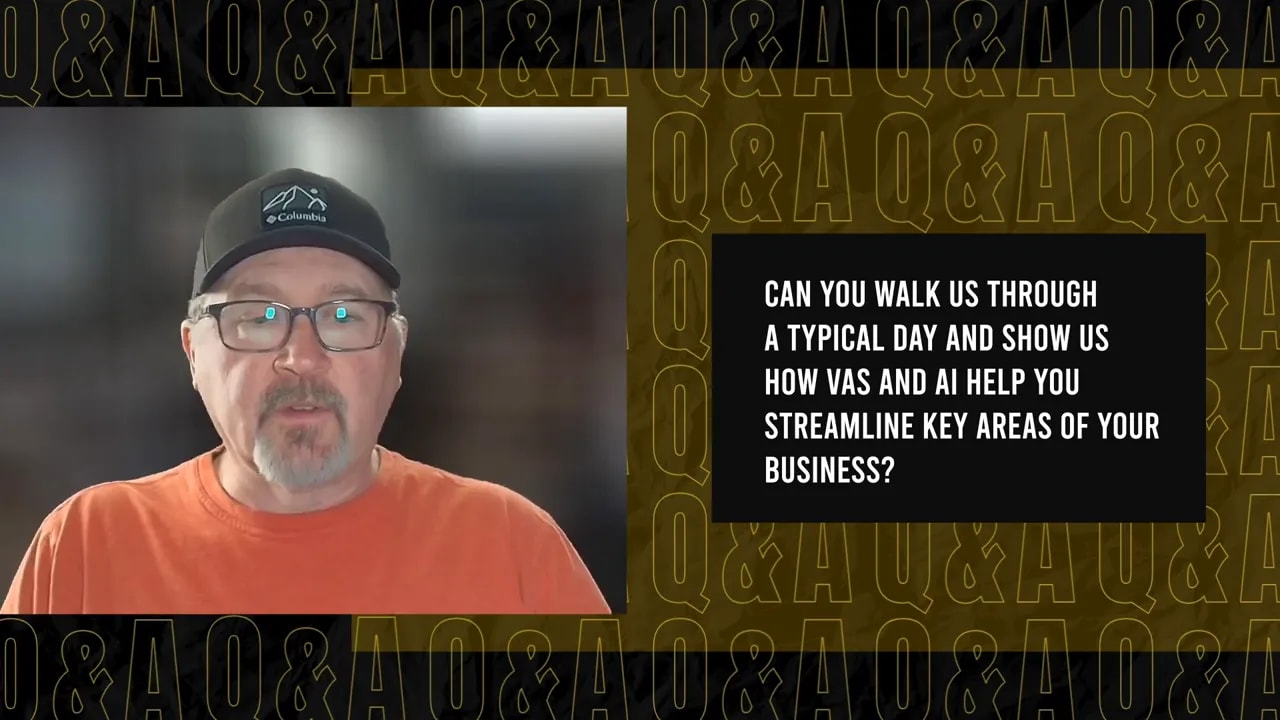
A simple VA + AI workflow for a typical business day

Photo by LinkedIn Sales Solutions on Unsplash
A practical operating rhythm might look like this:
- Create core content or business inputs
Record a podcast, outline an offer, answer client questions, or produce source material. - Send the raw material into AI tools
Generate descriptions, summaries, clips, or draft marketing copy. - Have the VA manage the output
Review the AI draft, improve it, upload it, post it, and organize follow-up actions. - Trigger related workflows
If leads come in, use templates and SOPs so the VA can respond fast. - Document the process
As the workflow gets better, convert it into a standard operating procedure.
Over time, the system improves because the team stops reinventing the same tasks.
How SOPs make this model scale
Without SOPs, AI and VAs can still help, but the results will be inconsistent.
Strong SOPs help define:
- What tool to use
- What prompt or input to start with
- What steps happen next
- Who reviews the result
- What quality standard must be met
Another useful point from the Business Ownership Coach | Investor Financing Podcast angle is that SOP creation itself can be delegated over time. Once the team understands the system, they can often document and improve the process instead of relying on the owner for every detail.
Common mistakes when using virtual assistants and AI
Most failures come from poor implementation, not from the idea itself.
1. Overcomplicating the tech stack
It is easy to collect too many tools. Start simple. Pick a small number of tools you will actually use every day.
2. Expecting AI to replace quality control

AI can produce fast output, but not always the best output. Human review still matters, especially for content, client communication, and brand presentation.
3. Hiring a VA without a clear workflow
If tasks are vague, results will be vague. Define repeatable responsibilities before expecting strong performance.
4. Keeping all process knowledge in the owner’s head
If only the owner understands the workflow, the business cannot scale. Documentation and delegation are critical.
5. Ignoring fit between task and tool

Different businesses need different workflows. Content-heavy businesses will use these tools one way. Real estate, lending, and home service businesses may use them differently for coordination, advertising, and lead handling.
How to get started without getting overwhelmed
The best advice is to start before everything feels perfect.
Use this simple plan:
- Identify one bottleneck
Choose content, admin, lead follow-up, or transaction coordination. - Choose one AI tool
Use it for a specific job, not everything at once. - Assign one VA-owned workflow
Make one person responsible for running the process. - Create a basic SOP
Even a short checklist is enough to start. - Refine over time
Test tools, keep what works, replace what does not.
This steady, practical approach fits the tone of the Business Ownership Coach | Investor Financing Podcast model. Keep it simple, use what works, and build from there.
Useful tools and support resources
If you want templates, prompts, and a business-oriented framework for combining virtual team members with AI, the Biz Scaling Playbook is a relevant resource.
If you are actively exploring virtual assistant support, this VA consultation page may also help you evaluate options.
Business owners looking at funding and growth strategy can book an advisory call or schedule an SBA discovery call if financing is part of the bigger scaling plan.
For ongoing updates on acquisitions, funding, and business ownership topics, the Business Ownership Newsletter is another useful reference point.
Final takeaway

The real advantage is not just hiring a VA or using AI. It is building a system where each makes the other more effective.
AI helps create speed. Virtual assistants help create execution. SOPs make the process repeatable. That combination can reduce bottlenecks, expand output, and let owners spend more time on selling, leading, and growing.
For anyone following the Business Ownership Coach | Investor Financing Podcast mindset, the opportunity is clear: build a leaner business by pairing global talent with practical automation, then improve the process as you go.